How house cleaning is priced: the units, the extras and what moves a rate
A house cleaning rate is set by the unit it is quoted in, the scope of the clean and the conditions attached to the job. This page measures each of those across the 4,738 US companies that publish a price, and links to the states and cities where you can compare them.
What sets a house cleaning rate?
What sets a house cleaning rate is the unit it is quoted in, the scope of the clean, and a handful of conditions that most companies never publish at all.
Which units do cleaning companies actually price in?
The units cleaning companies actually price in are these, counted across 16,152 published rates.
| Unit | Published rates | Share |
|---|---|---|
| Flat or per visit | 11,204 | 69% |
| Per hour | 1,781 | 11% |
| Per room | 484 | 3% |
| Per month | 341 | 2% |
| Per week | 200 | 1% |
| Per square foot | 119 | under 1% |
| Stated without a unit | 2,023 | 13% |
A flat price and an hourly price are different quantities, and no page on this site averages them together. The flat median is $165 per visit; the hourly median is $50.
Why is square footage discussed so much more than it is used?
Square footage is discussed far more than it is used because it is how companies describe a job and bedroom count is how they price it. 543 priced sentences across 361 company websites mention floor area, and only 119 published rates are actually quoted per square foot.
What do the add-ons cost?
The add-ons are priced per named item, alongside the main rate rather than inside it. The ones that recur across published price lists are the oven, the refrigerator, interior windows, baseboards, blinds and dishes. They matter for reading any price comparison, because an add-on priced at $15 or $40 is not a cleaning price and should never be averaged with one — a quarter of what looks like a published cleaning rate is an extra, a commercial job or an adjacent service.
How many companies publish a minimum charge?
The companies that publish a minimum charge are 145 of 4,738, about 3%, at a median of $125. Almost every company has one; almost none says so before you ask.
Do companies publish whether they are bonded and insured?
Yes, 237 companies mention insurance, bonding or background checks in the same breath as a price. It is the most common non-price claim attached to a published rate, and it is one of the few things a published page lets you verify before contacting anyone.
How often does the final bill beat the quote?
The question cannot be answered from published prices, because a published price is what a company advertises, not what it invoices. It can be approached from one source nobody else will publish about their own professionals: the reviews where a customer records both the quote and the bill.
Across 489,618 US house-cleaning reviews, 5,485 name a dollar amount and 206 record both numbers. In 202 of those 206 the bill was higher, by a median of $119 — about 43% over the quote. The median quote was $289 and the median bill $426.
⚠️ That is not an overrun rate, and it must not be read as one. People do not write a review to report that the bill came in as quoted: the 202-against-4 split is evidence about reviewing behaviour, not about the market. These reviews average 1.40 stars, with 90.6% at one or two, against 4.81 across all reviews. Their price level is correspondingly inflated and never feeds a figure anywhere else on this site.
Why does a bill go over the quote?
A bill goes over the quote for reasons the customer was told about in fewer than six cases in ten. Hand-read across all 202:
| Reason given | Share | Median overrun |
|---|---|---|
| None given at all | 42% | 40% |
| The job took longer than estimated | 25% | 40% |
| More cleaners came than quoted | 8% | 43% |
| Add-ons billed separately | 7% | 39% |
| The home was worse than described | 5% | 38% |
| The rate turned out to be per cleaner, not total | 5% | 114% |
| Travel, supplies, card or minimum fees | 3% | 10% |
| A deep clean applied on arrival | 3% | 56% |
The costliest misunderstanding by far is the last-but-two: a rate quoted as “$105 for three hours” that turns out to be $105 per cleaner, which doubles or triples a bill without anyone changing the scope.
Is a quoted range a quote?
No, and this is the industry’s own answer. Of these reviews 63% carry a reply from the business, and the defence that recurs is that a number given before seeing the home is a range, not a flat rate: “we do not guarantee the low end of a range for unseen homes”, “your initial service was quoted between $325.00 and $400.00 and we charged within that range you agreed to”. Others show the overrun was communicated and approved mid-service: “4 hours into the service we communicated that we would need an additional 2.5 hours and you agreed”.
Both things are true at once, and the practical lesson sits between them: ask whether the number you were given is a price or a ceiling, and get it in writing. Every figure above takes the top of a quoted range as the quote, so each one is the smallest defensible gap.
What does the published data not cover?
The published data does not cover tipping: 21 company websites of 4,738 mention it at all, which is too thin to state anything. It also does not cover what customers actually paid, which is a different and far more biased quantity — the method page explains why that is excluded.
Where can you compare real published rates?
You can compare real published rates by state and by city, each with the number of companies behind it and the date it was read.
What moves a cleaning rate, factor by factor
Service scope
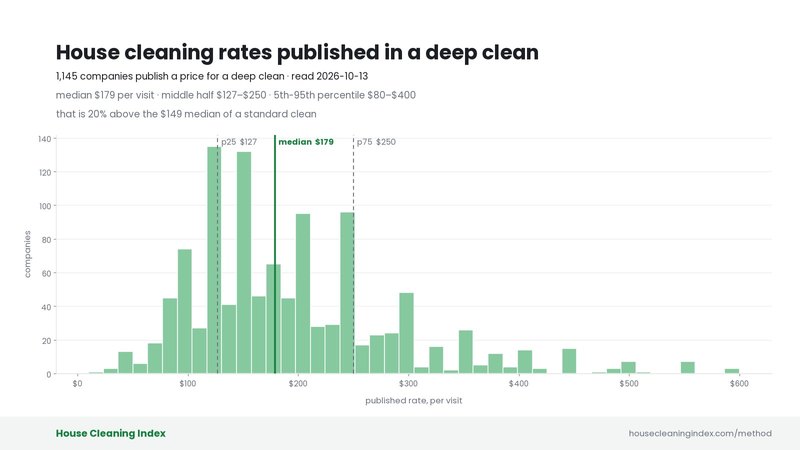
Deep cleaning carries the largest service premium in the market, and comparing companies to each other hides most of it.
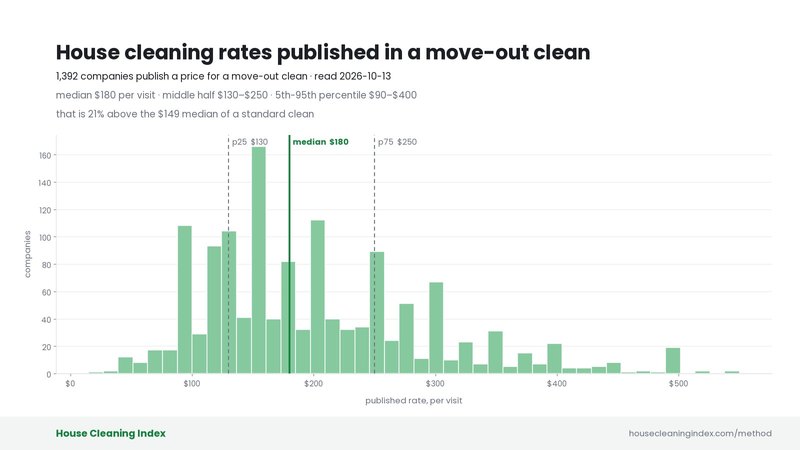
Move out cleaning carries the widest premium of any service in the published data, reaching 69% inside a single company.

